How a speaker works
A speaker has one job: copy a wiggle. The wiggle starts as a changing voltage in a cable and has to end up as a changing pressure at your ear, with the same shape at both ends. Everything inside the box exists to make that copy faithful.
Scroll to move the model. Drag it sideways to look around.
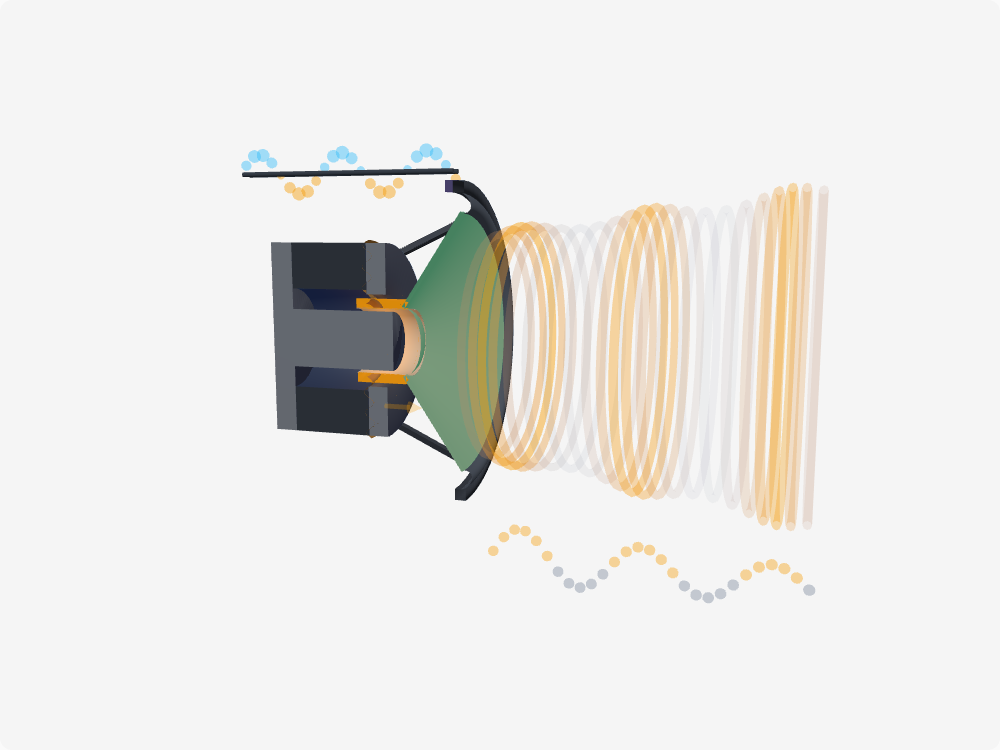
A current arrives
-
01
A current arrives
A current runs up the cable, rising and falling in exactly the shape of the sound that was recorded. Nothing has made a noise yet: this is only electricity in a wire. Watch the waveform ride down the lead and reverse direction twice per cycle.
-
02
Into the voice coil
The leads end at the terminals, and the wire behind them is wound into a coil of a few dozen turns on a light tube. The whole signal has to pass through it. That coil is the only part of the speaker the electricity ever touches.
-
03
A field waits in the gap
The coil hangs in a narrow slot between the centre pole and the top plate, with the permanent magnet feeding both. The field is squeezed into crossing that slot sideways, straight out from the axis. It never changes: only the current does.
-
04
Field and current make force
A wire carrying current across a magnetic field gets pushed, at right angles to both of them. The coil's turns run in circles and the field points radially, so the only direction left over is along the axis. Current has become a shove.
-
05
The force reverses
Send the current the other way and the force turns with it, because the field stayed exactly where it was. Half a cycle out, half a cycle back. That is why the coil vibrates about one place instead of flying off to one side.
-
06
The coil drags the cone
Coil, tube and stiff cone are glued into a single piece, so whatever the coil does the cone does too, hundreds or thousands of times a second. The suspension lets it travel along the axis and nothing else. A gram of wire is now moving a hand-sized disc of paper.
-
07
Crowding and thinning air
Driving forward, the cone crams the layer of air in front of it together; pulling back, it leaves that layer thinner than it was. Pressure rises and falls either side of the ordinary pressure of the room. The cone has stopped being electrical and is working as a pump.
-
08
The pattern travels out
A crowded layer shoves the next one and thins out again, and the shove keeps handing itself forward at about 343 m/s. No air makes the journey: each parcel jiggles a fraction of a millimetre and stays in its own place. What leaves the speaker is the pattern, not the air.
-
09
Your eardrum copies it
The pressure arrives and pushes and pulls your eardrum in the same rhythm. Hold the plot of pressure against distance next to the waveform still running up the cable: the same shape, two transductions apart. The speaker has done nothing but translate it.
The air does not go anywhere
This is the part almost everyone gets wrong, and the model is built to show it. Sound is not air travelling from the speaker to you. If it were, a concert would be a gale.
What travels is a pattern. The cone shoves the layer of air touching it; that layer crowds into the next one and shoves that; and the shove keeps handing itself forward at about 343 metres a second. Each individual parcel of air moves back and forth by a tiny fraction of a millimetre and ends the night exactly where it started. Watch the rings in the model: they bunch together and spread apart, but each ring stays in its own place. Only the bunching moves outwards.
Two details in the model are worth pausing on. The rings crowd together exactly where they are brightest, because the crowding is the pressure — they are not two effects, they are one quantity drawn two ways. And the brightest band is not where the cone is furthest forward, but a quarter wavelength ahead of it, where the air is moving forward fastest. Pressure follows velocity, not position.
A microphone is a speaker running backwards
Not “similar to”. The same mechanism, read in the other direction.
A dynamic microphone is a diaphragm glued to a coil of wire hanging in the gap of a permanent magnet. Pressure waves arrive, the diaphragm moves, the coil moves with it, and a coil moving through a magnetic field has a voltage induced across its ends. Current in, motion out becomes motion in, current out.
This is not a thought experiment: wire a small speaker into a microphone input and it works, badly but unmistakably. Old intercoms used one driver as both, switching it between the amplifier’s output and its input. It is also why a speaker connected to nothing is hard to push by hand, and much harder if you short its terminals — you are generating a current in the coil, and that current fights the motion that made it. Amplifier designers call that damping, and it is the reason a bass note stops when the signal does instead of ringing on.
Why woofers are big and tweeters are tiny
The loudness you hear depends on how much air the cone displaces, and displaced air is area multiplied by excursion. Neither is free.
A low note swings slowly. To keep shoving air at 40 Hz the cone has to travel a long way on every stroke, and even then a small cone runs out of room: to match the output of a 12-inch driver, a 4-inch one would need roughly nine times the excursion, which its suspension will not survive. So bass drivers get area — more surface, more air moved per millimetre of travel.
High notes have the opposite problem. At 15 kHz the cone reverses direction thirty thousand times a second, and accelerating a heavy cone that hard takes force nobody has. Worse, a large surface stops moving as a single piece at high frequencies and starts flexing into its own standing patterns, which sounds like neither the signal nor anything else. So tweeters get small and light: a one-inch dome, barely moving, is easy to accelerate and stiff enough to stay in one shape. No single cone is good at both ends, which is why a speaker box usually holds two or three of them and a crossover to decide which gets what.
What the model leaves out
The cone does not really follow the current. Above the driver’s resonant frequency — which is most of its useful range — the cone’s motion is limited by its own mass, and a mass driven by a force lags it by half a cycle. So the real cone is moving backwards while the current says forwards. The model keeps them in step because the point being made is that force follows current, and the phase relationship only muddles it.
The wavelengths are not to scale. In the cable the signal moves at a significant fraction of the speed of light; in the air it moves at 343 m/s. A 440 Hz note is about 780 millimetres long in air and hundreds of kilometres long in the wire. Drawing both to scale would leave one of them invisible.
Real radiation is not a beam. The model sends the sound out as a narrowing cone of rings because that is readable. A woofer whose cone is small compared to the wavelength radiates almost equally in every direction, including backwards — which is exactly why the box exists, to stop the rear output from arriving out of phase and cancelling the front.
One frequency at a time. The model runs a clean sine wave. Music is hundreds of frequencies at once, and the cone traces their sum: a single complicated squiggle that happens to contain all of them. Your ear takes the sum apart again.
The parts
- Cone (diaphragm)
- The stiff paper, plastic or metal surface that moves the air. It wants to be light so it can be accelerated, and stiff so it moves as one piece instead of flexing into its own shapes.
- Voice coil
- A few dozen turns of fine wire wound on a tube, hanging in the magnet's gap. It is the only part the signal actually touches, and it is what turns current into force.
- Permanent magnet
- A ring of ferrite or neodymium that supplies a fixed magnetic field. It never changes; only the current does. That is what makes the output follow the signal rather than fight it.
- Magnetic gap
- The narrow slot between the centre pole and the top plate, where the field is squeezed into crossing radially. The coil lives in there with a fraction of a millimetre of clearance on each side.
- Surround
- The flexible roll joining the cone's rim to the frame. It seals the front from the back and lets the cone travel along its axis without letting it wander sideways.
- Spider
- The corrugated fabric ring behind the cone. It carries most of the restoring force and keeps the coil centred in a gap far too tight to survive it touching the sides.
- Basket (frame)
- The cast or stamped chassis everything else is bolted to. It has to hold the magnet and the suspension in alignment while the cone shoves against it thousands of times a second.
- Compression
- A region where the air has been crowded together and the pressure is momentarily above normal. It is a pattern moving through the air, not a lump of air moving.
- Rarefaction
- The other half of the cycle: a region left thinner than normal, with pressure momentarily below ambient. Compressions and rarefactions alternate half a wavelength apart.
- Excursion
- How far the cone travels from rest. Doubling the excursion doubles the air displaced, which is why bass drivers need room to move and tweeters barely move at all.
- Impedance
- How much the coil resists the amplifier's attempts to push current through it. It is quoted as a single number, usually 4 or 8 ohms, but it varies enormously with frequency.