How a heat pump works
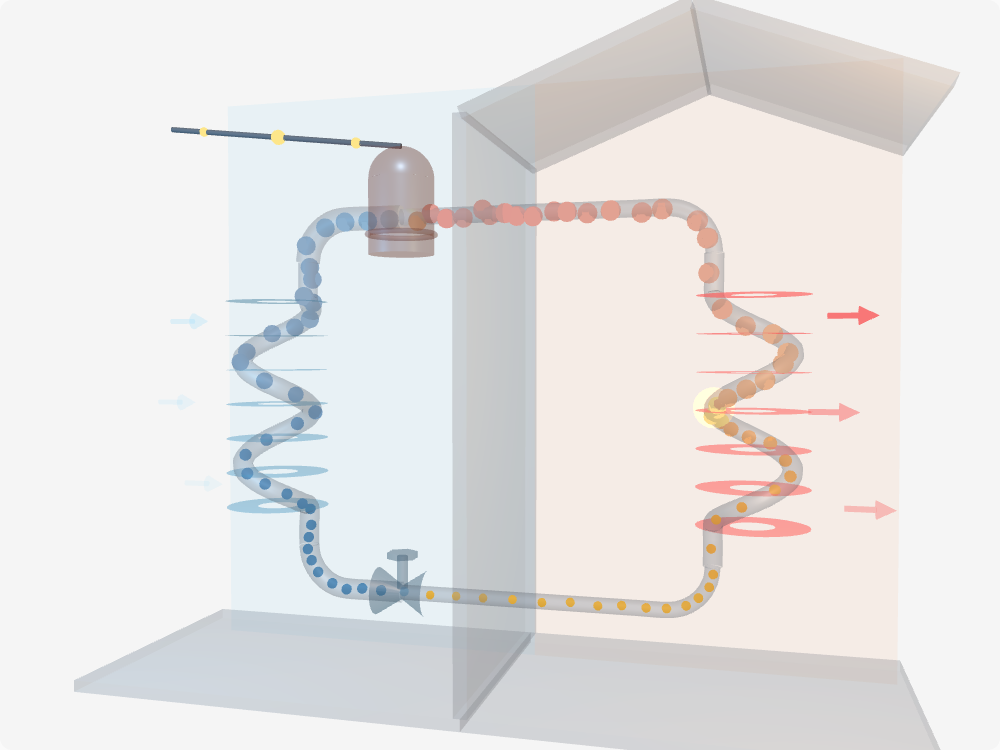
A heat pump is not a heater. It is a pump, and what it pumps is heat — out of air that feels freezing to you and into a room that is already warmer than that air. Nothing is burnt and nothing is generated. Follow one parcel of refrigerant all the way round the loop and you have the whole machine.
Scroll to move the model. Drag it sideways to look around.
Colder than the cold outside
-
01
Colder than the cold outside
Follow the bright parcel. It enters the outdoor coil as a low-pressure mush of liquid and vapour at around -10 °C, and that single number is the trick of the whole machine: it is colder than the winter air standing around the coil. It is that cold because the valve it just came through dropped its pressure, not because anything is cooling it.
-
02
Heat flows in and boils it
Heat only ever moves from hot to cold, so the outdoor air — freezing to you, balmy to the refrigerant — pours heat into the pipe. But the fluid is already sitting at its boiling point, so that heat does not raise its temperature: it boils it, liquid into gas. That is latent heat, and it is why a coil this size can carry so much energy while barely changing temperature.
-
03
The compressor squeezes it
The refrigerant leaves the coil as a cold, low-pressure gas and is drawn along the fat suction line into the compressor. This is the only part with moving parts and the only part that draws electricity — the beads on the cable are all the energy the machine is ever given. Everything else in the loop happens on its own, driven by differences in pressure and temperature.
-
04
Squeezed gas gets hot
Compress a gas and it heats up, the same reason a bicycle pump gets warm in your hand. It leaves the discharge port genuinely hot — hotter than your living room, which is the point of the exercise, because heat cannot flow into a room unless the pipe carrying it is hotter than the room. No heat was created here; it was raised to a temperature you can actually use.
-
05
Now hotter than the room
The discharge line crosses the wall, and indoors the situation is reversed: the pipe is the hot thing and the room is the cold one. So the same rule that filled the refrigerant with heat outside now empties it, and heat streams out of the coil into the air of the house.
-
06
The gas turns liquid
Losing that heat barely cools the gas — it condenses it back into liquid instead, again at almost constant temperature. This is the latent heat it absorbed outside being handed back, plus the work the compressor put in. Everything the house receives is delivered on this one coil.
-
07
A deliberate constriction
The liquid leaving the house along the thin bottom line is still warm, and still on the high-pressure side of the loop. Waiting for it is the expansion valve: a narrow gap, deliberately built as a bottleneck, and the only thing separating the loop's high-pressure half from its low-pressure one. Forcing the liquid through it is what makes the pressure collapse.
-
08
Cold again, ready for more
The moment it squeezes through, part of the liquid flashes to vapour, and taking that latent heat out of what remains drags the temperature back below the outdoor air. The parcel is cold again, back where it started, and the lap is complete. Nothing on this loop ever made heat: it only carried it from one side of the wall to the other.
A fridge and an air conditioner are the same machine
There is only one machine on this page. A fridge runs exactly this loop: the evaporator is the panel inside the food compartment, the condenser is the warm grille on the back, and the heat pulled out of your milk is dumped into your kitchen. An air conditioner runs it with the evaporator indoors and the condenser outdoors. An air-source heat pump runs it the other way round.
Same four parts, same refrigerant, same cycle. What changes is which side of the wall each coil sits on, and which side you decided to care about. A fridge is a heat pump that heats your kitchen — you just never bought it for that.
Why a heat pump can be 300% efficient
An electric resistance heater turns 1 kWh of electricity into 1 kWh of heat, and that is the ceiling. You cannot get more energy out of a conversion than you put in.
A heat pump is not doing a conversion. The electricity does not become the heat; it runs a pump, and the heat is cargo. For 1 kWh off the meter a decent air-source unit delivers 3 to 4 kWh into the house, because most of what it delivers was already out there in the cold air and only had to be carried in. That ratio is the COP, and it is a transport efficiency, not a conversion efficiency. Nothing is violated: what comes out of the condenser is the heat taken from outside plus the compressor’s work, and both were paid for.
The COP is not a constant. It depends on how far the machine has to lift the heat — the bigger the gap between the outdoor temperature and the temperature you want indoors, the harder the compressor has to squeeze and the worse the ratio gets. The same heat pump that returns 4.5 at 12 °C outside might return 2.2 at -7 °C. This is also why heat pumps pair badly with old high-temperature radiators and well with underfloor heating: asking for 35 °C water instead of 70 °C almost doubles the COP.
In summer the cycle runs backwards
Add one component — a four-way reversing valve on the compressor — and the machine cools instead. The compressor keeps sucking from one port and discharging from the other, exactly as before; the valve simply swaps which coil each port is connected to, so the refrigerant travels round the loop in the opposite direction. The indoor coil becomes the evaporator and takes heat out of the room, the outdoor coil becomes the condenser and dumps it into the street.
That is the entire difference between a heat pump and an air conditioner: one valve. The same trick is used in winter for defrost cycles, when the outdoor coil ices over and the unit briefly runs in cooling mode to melt it off.
What the model leaves out
The model has one expansion valve pointing one way. A real reversible system needs the expansion to work in both directions, which means either an electronic valve that does not care, or a pair of fixed devices with check valves bypassing them.
Both coils are drawn bare. In the real thing each is a dense block of finned tube with a fan dragging air across it, because air is a poor conductor and you need a lot of surface area to get heat into it. That fan is the second thing consuming electricity, and the reason an outdoor unit is audible.
And nothing here shows pressure directly, even though pressure is what the whole cycle is built on. The loop has exactly two of them: high from the compressor round to the valve, low from the valve round to the compressor. Two components create that boundary and the other two live on either side of it. It is what lets the same fluid boil at -10 °C in one coil and condense at 45 °C in the next.
The parts
- Refrigerant
- The working fluid. It is chosen so that its boiling point lands between the two temperatures you care about once you pick the pressures — cold enough to boil in winter air on the low side, hot enough to condense against a warm room on the high side.
- Evaporator
- The coil where the refrigerant boils. It is the cold side, and it is cold because the pressure there is low, not because anything is cooling it.
- Compressor
- The pump. It raises the pressure of the gas, which is what creates the two pressure zones the whole cycle depends on, and it is where the electricity goes.
- Condenser
- The coil where the refrigerant condenses back to liquid and gives up its heat. In heating mode it is indoors; in an air conditioner it is the box outside.
- Expansion valve
- A controlled restriction between the high and low sides. It sets how much refrigerant is allowed through, and the pressure drop across it is what makes the fluid cold.
- Latent heat
- The energy a substance absorbs or releases when it changes state, with no change in temperature. It is why both coils work at nearly constant temperature, and why the cycle can move so much energy for its size.
- Superheat and subcooling
- How far past boiling the gas is at the compressor inlet, and how far below condensing the liquid is at the condenser outlet. Both are margins: superheat keeps liquid out of the compressor, subcooling keeps vapour out of the valve.
- COP (coefficient of performance)
- Heat delivered divided by electricity consumed. A value of 3.5 means 3.5 kWh into the house per kWh off the meter. It falls as the gap between outdoor and indoor temperature grows.
- Reversing valve
- A four-way valve that swaps which coil the compressor discharges into. Flip it and the indoor coil becomes the evaporator: the same machine now cools the house.