How a four-stroke engine works
Every petrol engine turns fuel into rotation the same way: the piston makes four passes up and down the cylinder, and each pass does one job. Here they are, one at a time.
Scroll to move the model. Drag it sideways to look around.
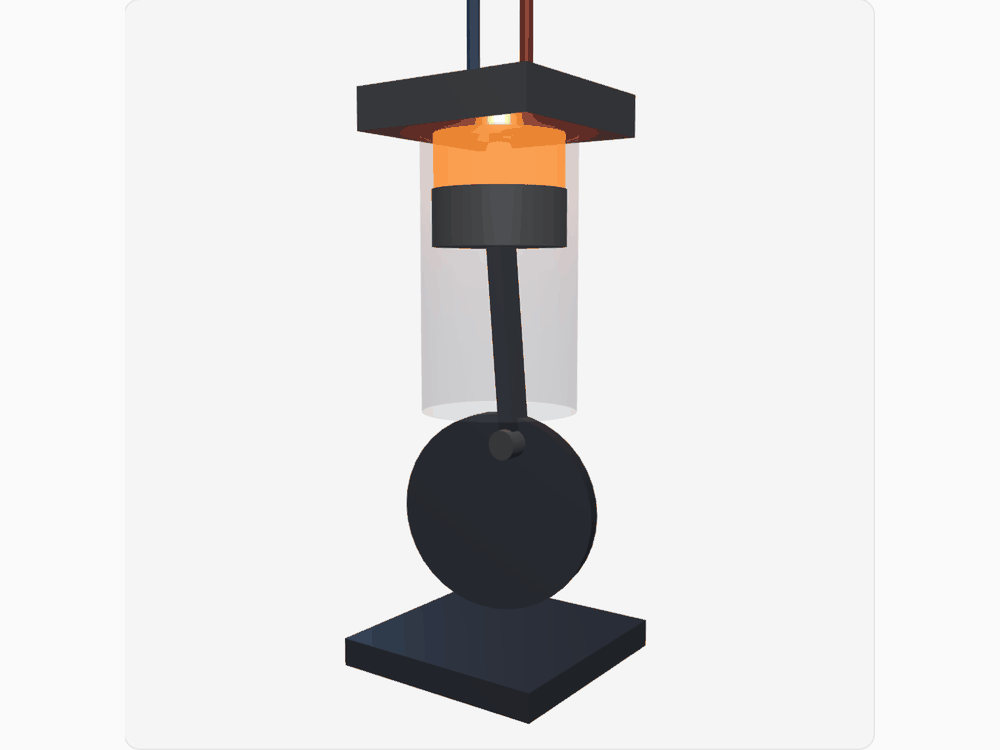
Intake begins
-
01
Intake begins
The piston starts down from the top of the cylinder and the intake valve lifts off its seat. The chamber above the piston crown is now open to the intake port, and it is growing.
-
02
Air pushes the mixture in
As that space grows, the pressure inside falls below atmospheric. Nothing sucks the mixture in — the outside air is at the higher pressure and pushes it through the open valve until the piston reaches the bottom.
-
03
Both valves close
The intake valve shuts and the chamber is sealed: no way in, no way out. The piston turns around at the bottom and starts back up, and the mixture it trapped has nowhere to go.
-
04
Squeezing it heats it
Same mass of mixture, a fraction of the room — it gets denser and hotter as it is compressed. How much smaller that space gets is the compression ratio, and it sets how much work the burn can hand back.
-
05
The spark fires
Just before the piston reaches the top, the spark plug arcs across its electrodes and lights the mixture. It burns in a few thousandths of a second, and the pressure in the sealed chamber climbs far past anything compression alone reached.
-
06
The burn drives it down
That pressure has one thing it can move, and it pushes the piston all the way down to the bottom, turning the crankshaft through the rod. This is the only stroke that produces power; the other three are paid for out of it.
-
07
Burnt gas is pushed out
At the bottom the exhaust valve opens and the piston rises again, sweeping the spent gas out through it. What is left in the cylinder has already given up its energy — it is only in the way now.
-
08
Two turns, one power stroke
Near the top the exhaust valve settles back onto its seat and the piston is where it started, ready for the intake valve to open again. Four strokes, two full turns of the crankshaft, and only one of them pushed.
Why four strokes and not two
Each stroke does exactly one job, and jobs that fight each other are kept apart. Filling the cylinder wants low pressure and open valves; burning wants high pressure and a sealed chamber. Separating them costs a full extra revolution of the crankshaft, and in exchange the engine breathes cleanly and burns what it took in.
A two-stroke engine merges these jobs to get a power stroke every revolution. It makes more power for its size, and it pays for that with fresh mixture escaping out the exhaust port before it has been burnt.
The crankshaft turns twice per cycle
This is the detail that catches people out. Four strokes means the piston changes direction four times, and each change of direction is half a turn of the crankshaft — so one complete cycle is two full revolutions, not one. In a four-cylinder engine the cylinders are staggered through that cycle, so there is always one on its power stroke and the engine pulls smoothly rather than in lurches.
What the model leaves out
Real engines open the valves earlier and close them later than the strokes they belong to, and there is a window near the top where both are briefly open at once. It is called valve overlap, and it exists because moving gas has inertia worth exploiting. The model keeps each valve inside its own stroke, because the thing worth learning first is which valve goes with which job.
The parts
- Piston
- The sliding plug that seals the cylinder. Gas pressure pushes on its crown; that push is the engine's entire output.
- Connecting rod
- Links the piston to the crankshaft. It converts the piston's straight-line travel into rotation, which is why it swings sideways as the crank turns.
- Crankshaft
- The offset shaft the rod drives. Its offset from the centre line is half the stroke — double it and the piston travels twice as far.
- Top dead centre (TDC)
- The highest point of piston travel. The piston is momentarily stopped here, which is why the spark fires slightly before it.
- Bottom dead centre (BDC)
- The lowest point of piston travel. Intake ends here, and so does the power stroke.
- Intake valve
- Opens during the intake stroke to let the air-fuel mixture in, then seals the chamber for compression.
- Exhaust valve
- Opens during the exhaust stroke to let burnt gas out. It runs far hotter than the intake valve, which never sees combustion.
- Spark plug
- Fires an arc across its electrodes to start the burn. Petrol engines need it; diesels do not, because compression alone gets hot enough.
- Stroke
- One full pass of the piston from one end of its travel to the other. Four of them make a cycle, which takes two crankshaft revolutions.